- This year, for the first time, the artists for the Kazakhstan Pavilion were selected through an open call. In your view, how successful was this format of selection?
- In my view, this is a very sound and important initiative. An open call gives all participants equal opportunities and makes the decision-making process more transparent. Most importantly, it fosters open dialogue within the art community.
Of course, since this was the first experience of its kind, aspects requiring refinement may emerge in the future. But despite that, I believe this is precisely the format that has a positive impact on the development of contemporary art in Kazakhstan. If this practice continues in the future, I will gladly share my experience.
- Tell us about the selected artists, their works, and where in Kazakhstan these works can be seen.
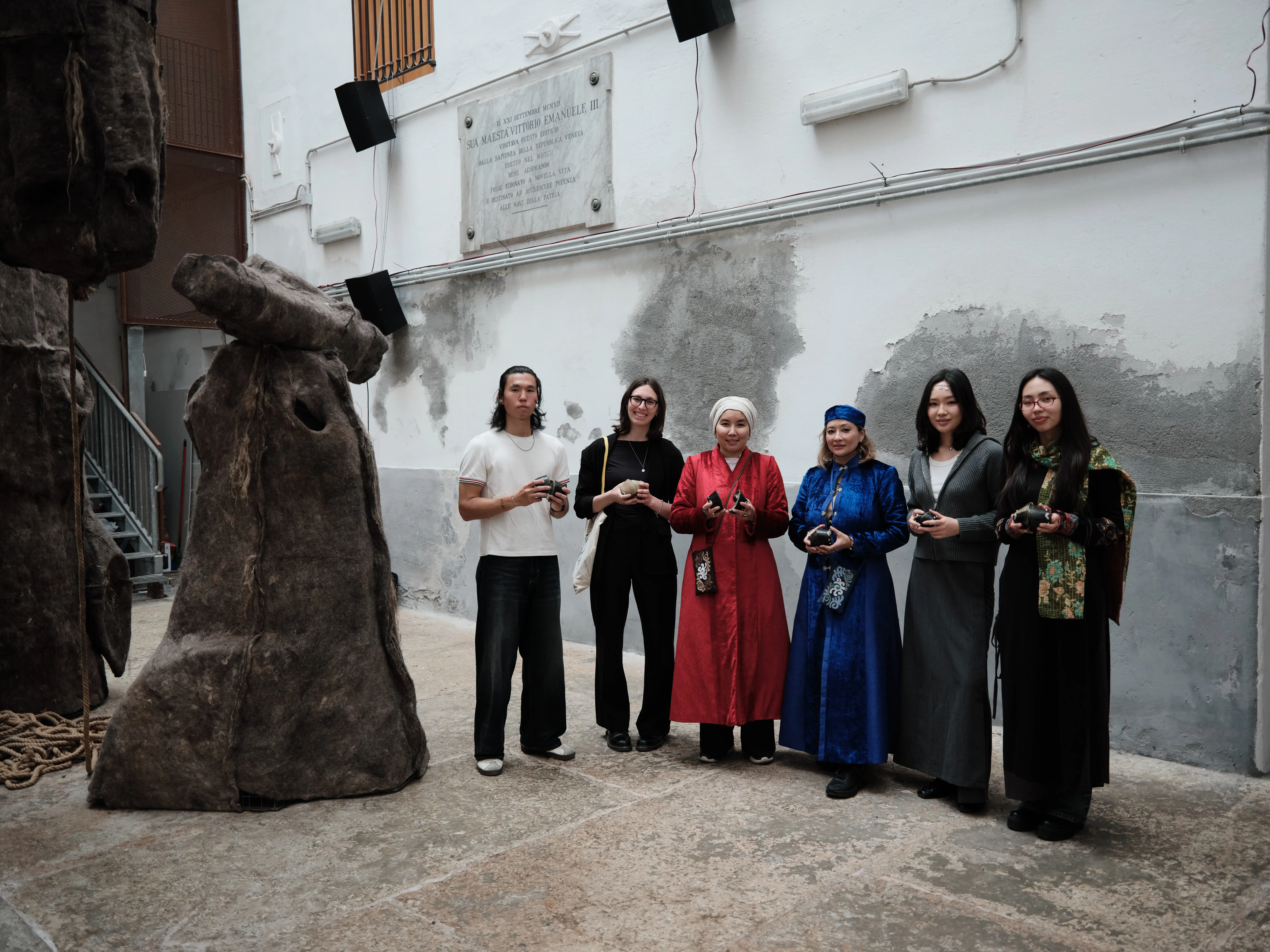
- The project featured Smail Bayaliyev, Akmaral Mergen, Gulmaral Tattibayeva, Natalya Ligay, Mansur Smagambetov, Oralbek Kaboke, Nurbol Nurakhmet, Anar Aubakir, and Ardak Mukanova.
For example, Smail Bayaliyev’s work Steppe Architectonics explores nomadic space and the role of the horse in shaping steppe culture. Akmaral Mergen’s sound installation Dübir creates the exhibition’s acoustic space and, through multichannel sound, makes it possible to feel the atmosphere of the steppe. The performative actions of Gulmaral Tattibayeva and Natalya Ligay in urban space influenced the concept of Dübir. In his works, Oralbek Kaboke reflects on Kazakh identity, historical memory, and the connection between human beings and their native land. Mansur Smagambetov and Nurbol Nurakhmet address the theme of the Semipalatinsk Test Site through everyday experience and personal memories. Anar Aubakir explores the transformation of historical memory and identity through family history, while Ardak Mukanova, through the image of the Konyr-Aulie cave, reveals themes of memory, rebirth, and inner spiritual quest.
Today, these works can be seen in precisely this form only at the Kazakhstan Pavilion at the Venice Biennale, with the exception of some projects that exist in digital format. Those who want to become acquainted with the artists’ work more broadly can visit their exhibitions in Kazakhstan or contact the artists to visit their studios.
- If the open-call practice continues, what advice could you give to creative people who had not heard about the open call or did not dare to take part?
- If such competitions continue to be held, the most important thing is to see this format not as a “closed system” but as an open opportunity. Quite often, people who do not take part in such projects believe that their work may be undervalued, or they doubt the outcome in advance.
In this regard, I can give an example from my own experience. While working on the project, there were colleagues who were initially skeptical both about the project itself and about my capabilities. Later, we saw how those views changed.
Therefore, my advice to every artist who believes in their experience and their ideas is to make a point of applying to such open calls.
In addition, such open formats have a positive effect on the development of the creative community as a whole. That is why the courage to present your ideas to the public is one of the most important steps.
After all, a competition is not only about victory or defeat. It is an important opportunity to test your work in a professional environment.

- How did the process of preparing such a large-scale exposition unfold? Does the exposition really occupy six halls? Were there any preliminary showings or work with focus groups?
- Preparing the exposition was a complex curatorial undertaking consisting of several stages. The main challenge, perhaps, was the lack of time. The pavilion includes six spaces (halls), each structured as an independent thematic block, brought together within a unified curatorial narrative. The entire exhibition was conceived in the format of a visual essay.
The work began with clarifying the concept and maintaining an ongoing dialogue with the artists. Each work was considered not only on its own but also in the context of its semantic connection with the other works.
During the preparation, several internal viewings and discussions took place. At these stages, technical solutions, work with the space, and the interaction of sound and visual elements were considered. In addition, thanks to the exchange of opinions within the team and with partners, some decisions were revised and refined.
It would not be entirely accurate to say that a full-fledged study was conducted in the format of focus groups. However, professional discussions and feedback from curators and partners did, to a certain extent, serve that function.
Overall, the entire process was built on open dialogue. At the same time, the most important task was to preserve the integrity of the exposition while also emphasizing the autonomy of each work.
- Are there stages of preparation in the visual arts, or a kind of “rehearsal,” that can affect the exhibition’s final appearance?
- Absolutely. Especially in large curatorial projects and immersive exhibitions, there are stages of preparation and a kind of “rehearsal,” although they do not have as fixed a form as they do in theater.
Most often, this process involves testing the concept, testing the space, and observing how the works interact with one another. Each installation is assessed not only on its own, but also in the context of the exposition’s overall dynamics.
At the same time, in the visual arts the final result is often shaped directly during the installation (mounting of the exhibition) in a specific space. Therefore, it is more accurate to speak not of rehearsal in the classical sense, but of a continuous process of adjustment and adaptation