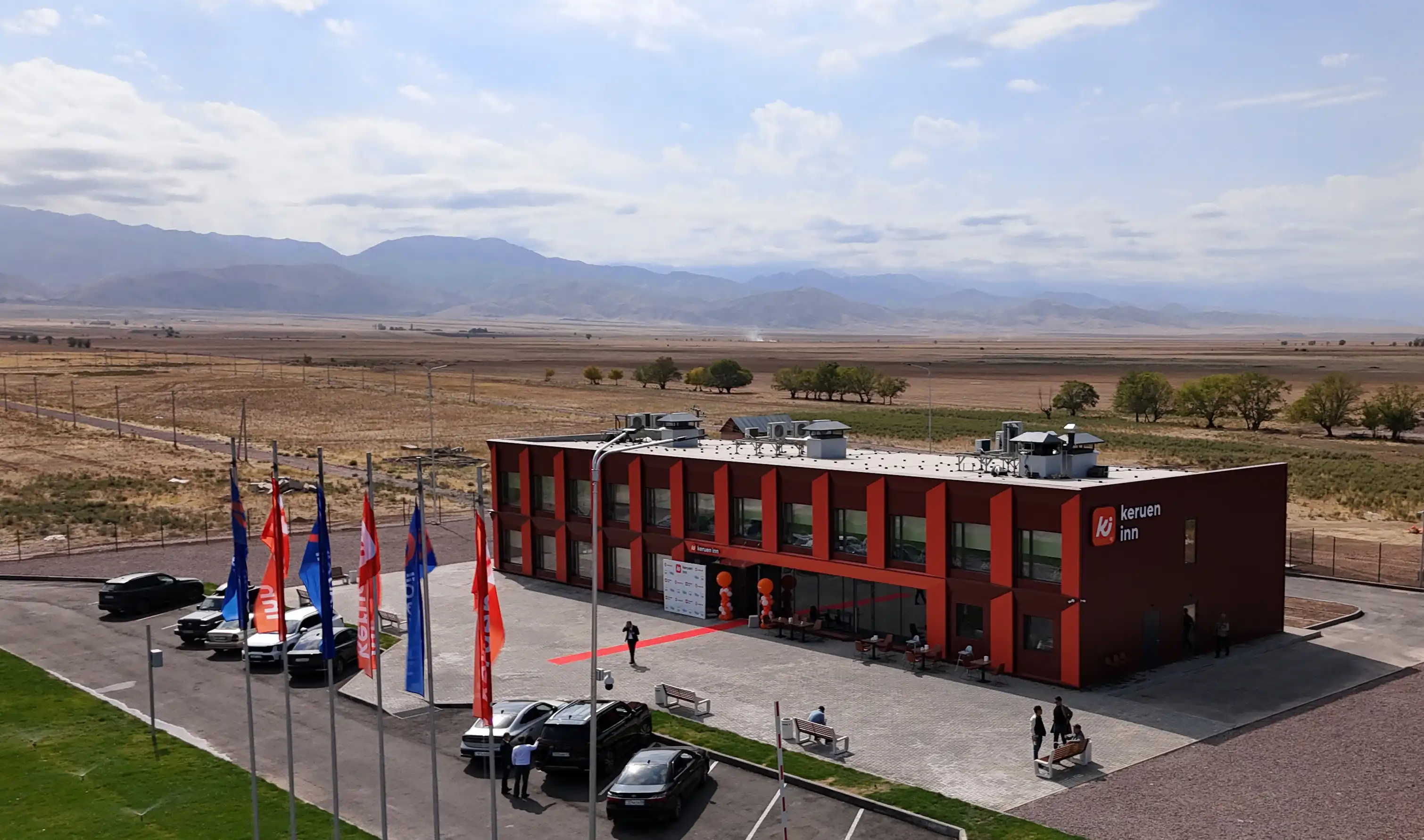
Development of the Keruen Inn network
On September 17, 2025, Qazaq Oil launched the first hotel in the chain under the Keruen Inn brand, setting a new standard for Kazakhstan’s entire hospitality industry. The project was completed in record time: 180 days passed from piloting the business idea to the ribbon-cutting ceremony.
Today, the company operates six hotels under the Keruen Inn brand, located at strategically important points across the country: Merke, Aralsk, Semey, Atyrau, Aktau, and Karkaralinsk. The company is pursuing an ambitious scaling strategy: over the next four years, it plans to expand the network to 60 hotels nationwide.
Concept and technologies
Keruen Inn’s business concept was built on the results of a comprehensive analysis. Traffic flow factors, regional specifics, and the real needs of guests were taken into account. As a result, the company placed its bet on an affordable and comfortable accommodation format for travelers and professional drivers. At the same time, the level of comfort at Keruen Inn hotels was not to fall short of the standards of urban-format hotels.
A key stage was the choice of construction technology. Given the remoteness of the regions, harsh climate conditions, and the need to ensure the highest quality while maintaining a rapid pace of construction, the decision was made in favor of modular construction.
The work proceeded simultaneously in several directions: offers from manufacturers in China, Europe, and neighboring countries were studied. The domestic company VDS was chosen as the strategic partner, with whom Qazaq Oil already had successful experience working together. This made it possible not only to accelerate project implementation, but also to ensure a high level of localization and quality control at every stage. Gennady Morozov, shareholder of VDS Kazakhstan, spoke about the company’s operations and the principles behind its project work. VDS is a company with Belarusian roots. The main areas of our business are the development and production of advertising equipment for leading oil companies and the comprehensive design of urban space. For thirty years, we have been engaged in the development of fuel retail, and for more than 15 of those years we have worked in the Kazakhstan market. During this time, we developed brands and architectural concepts for Qazaq Oil, Royal Petrol, Compass, Nomad, Gasenergy, Sinooil, and Helios. Importantly, the absolute majority of our developments achieved unquestionable market success. We delivered thousands of facilities across the country, from mini filling stations to highway complexes, which allowed us to build unprecedented expertise in the construction of roadside infrastructure even in the most challenging logistical, climatic, and seismic regions.
VDS proprietary methodology
New realities require businesses to find unconventional solutions; template-based approaches no longer work. It is important to understand that breakthrough ideas require deep refinement aligned with the client’s business objectives and must be allowed room for error at the piloting stage. A strategy formed at the outset, even by the most decorated marketers and analysts, may be adjusted in the early stages of a project. This is not a failure, but an investment in a product that will later bring success to the business.
We carry out development using a proprietary methodology that has stood the test of time. The approach is based on teamwork. VDS specialists in design, engineering, technology, production, logistics, installation, and service work in full alignment with the client at every stage of development.
Defining the task is the first and key stage on which the success of the project depends. Only after the business objective has been formulated does the creative team begin its work. We start with creative exploration and the philosophy of the image; at the next stage, we work on the architecture. At the piloting stage, we verify the design solutions and technologies. After refining and approving the solutions, we prepare the product for serial production and replicate it. Development concludes with patenting.
The Keruen Inn project is being implemented using the VDS proprietary methodology. With the customer team fully involved, we went through the stages of creative development and piloting, and today we are producing the product in serial production.
Aleksandr Artyukhovich, managing owner of VDS, spoke about the project’s implementation and the challenges that had to be addressed
Project launch
As early as the project-definition stage with the shareholders of Qazaq Oil, we understood that Keruen Inn was not just another project for our team, but a real challenge. The request was for unprecedented speed in development, production, and installation, while also ensuring a long service life. The quality requirements proved extraordinary: to deliver benchmark soundproofing and air exchange to five-star hotel standards. All of this was so that every guest could truly rest, regardless of where the hotel was located. We accepted this challenge with great responsibility and set a high bar from the very beginning.
Our first task was to align within the team on what the future Keruen Inn hotel should be and to present our solution to the client. The development required deep immersion in a product that was new to the market—we visited more than twenty hotels in Europe and studied the best international practices in operations management, construction technologies, and operations. Within 40 days, we produced and presented prototypes—actual rooms of the future hotel. After receiving approval from the head of the investment headquarters of the Government of the Republic of Kazakhstan and a shareholder of Qazaq Oil, we launched work on the pilot hotel.
We completed the pilot hotel in Merke in 180 days. Of those, 120 days were spent working through the technical specifications, and we needed only 40 days for construction and installation. Today, we assemble a hotel in 28 days and know how to reach the 24-day benchmark.
The first hotel proved that modular technology is not inferior to conventional construction methods in terms of comfort and service offering, while surpassing them several times over in construction speed.
Synergy of technologies
In parallel with the Keruen Inn hotels, we were also working on the STADLER project. At a certain point, it became clear that the principles by which modular hotels are built largely coincide with the approaches used in modern railcar manufacturing, shipbuilding, and aircraft manufacturing. The limited area of a modular hotel room, like a ship cabin or an aircraft cabin, requires engineering ingenuity in working with space. In this way, the market pushed us to design and create solutions not within a perimeter, but in volume.
We analyzed the best engineering and design practices from these high-tech industries and adapted them for Keruen Inn hotels. This allowed us to bring the highest standards in plastics, ergonomics, and material durability into the hotel business.
Design solves business challenges
In the Keruen Inn project, we encountered a fundamental contradiction of the modern hotel business: how to create a universal product that can operate effectively in completely different price segments. We deliberately moved away from the generally accepted “star rating” standards and offered the market a new self-sufficient solution, in which the same room stock can address diametrically opposite objectives.
The basic architecture and engineering solutions of our product are universal, while the main lever for managing economics is the modular platform for service configuration. Depending on the room fit-out, the hotel can be tailored to a specific market, location, and business model.
The built-in principles of modularity effectively solve the challenge of full-scale renovation without shutting down hotel operations. Key exterior and interior elements are made as quick-release modules, and replacing elements takes not weeks, but a matter of hours. As a result, renovation becomes a manageable and fast process without harming operations.
Reformatting
Initially, we focused on the needs of professional drivers as Keruen Inn’s primary customer. The concept of the first hotel included an expanded set of services and amenities for long-haul drivers: showers, laundry rooms, ironing rooms, and a café area. We expected this segment to become the core audience of Keruen Inn. We implemented the first two hotels in this format and realized that the strategy was not working. The customer we had bet on was not inclined to spend money on hotel accommodation.
We piloted the third hotel in a hostel format, creating even more affordable conditions for the customer. However, this solution did not help either: demand was significantly below expectations. It became obvious that we needed not to adjust the details, but to completely rethink the strategy and look for a new format that the market would respond to.
By the fourth hotel, we had arrived at a long-term format. This is a hotel aimed primarily at young families and modern travelers. At the core of the concept is the transformation of space to meet the guest’s needs. The room ceased to be just a place to sleep: now the space adapts to the guest’s needs, rather than forcing the guest to adapt to a standard layout.
Thanks to thoughtfully designed pull-out mechanisms, the guest can choose the preferred sleeping arrangement: one large bed or two twin beds. For families with children, we provided additional sleeping places that fold out at night on the principle of compartment-car berths and take up no space when folded. Guests staying at the hotel during a business trip have access to a full-fledged workspace, which we integrated into the room.
The Heritage project
While working on the Keruen Inn project, we began to think that a modern hotel could be more than just a place to stay overnight—it could become a true platform for cultural exchange and education. This is how our large-scale educational project “Heritage” was born, and it became the centerpiece of the company’s marketing strategy.
This initiative is aimed at promoting the unique regions of Kazakhstan, shaping cultural values, and fostering patriotism. On a national scale, the project contributes not only to the development of domestic tourism, but also to cultivating deep respect for national traditions. It creates a strong connection between generations and opens new horizons for the professional and personal growth of every guest.
Thus, Keruen Inn is becoming not just part of the infrastructure, but a destination where a traveler can not only rest in a comfortable room, but also connect with the rich history and culture of our country.
New Horizons
The Keruen Inn project opened up an entire market for us. We have absolutely mastered modular construction technology and are not limiting ourselves to hotels, but are looking much more broadly. In Kazakhstan, we have agreements with Keruen Inn for the exclusive supply of modular hotels, and we work with only one partner. But the product has already found a response far beyond Kazakhstan.
In the Russian market, we are implementing three projects at once using modular technologies: a pilot project to build modular patient hotels at regional hospitals in Naryan-Mar, rotational camps for workers in the oil production industry, and modular hotels for the tourism cluster in the North Caucasus. All of these projects are being implemented under conditions shaped by the remoteness of the regions, the presence of permafrost, and a harsh climate, which proves the versatility and demand for modular solutions.
Recognition
VDS’s portfolio already includes a number of landmark projects that have elevated Kazakhstan to the global level in design and technology. There are indeed very few such examples. “Atyrau Köpіrі Bridge” and “Dome over the Citadel” have received international recognition, becoming hallmarks of domestic engineering.
The “Atyrau Köpіrі Bridge” project won the ArchDaily & Strelka Award in 2021 and was published on the international portals ArchDaily and Parametric Architecture. “Dome over the Citadel,” implemented under the patronage of UNESCO, became one of Kazakhstan’s most notable architectural achievements in the preservation of cultural heritage. The project was highly praised by the international community at the Architizer A+Awards, one of the most prestigious architectural awards in the world.
Keruen Inn is our third large-scale project that deserves recognition of its engineering and management potential at the global level. In 2026, we intend to seek nomination for the world’s most prestigious awards in design, architecture, and innovation. This is not a pursuit of awards, but a deliberate strategy intended to demonstrate Kazakhstan’s readiness to independently create, manufacture, and successfully operate the most technologically advanced hotels in the world