Energy infrastructure largely determines the pace of economic growth, the investment attractiveness of regions, and the stability of industrial operations. Amid rising energy consumption, the launch of new production facilities, and the development of renewable energy, modernization of the power grid complex is becoming one of Kazakhstan’s strategic objectives. Today, KEGOC is implementing several major infrastructure projects at once, two of which are of particular importance for the country’s entire Unified Power System: strengthening of the power grid in the Southern zone and integration of the West Kazakhstan power system with the main part of the UPS. These projects are shaping a new energy framework for the country, increasing the reliability, transmission capacity, and flexibility of the national power system.
KEGOC is consistently implementing a large-scale modernization program for the national power grid infrastructure. Against the backdrop of structural changes in the economy, growing network load, and the need to connect new generating capacity, the company is strengthening key areas of the Unified Power System of Kazakhstan.
Today, two major projects are in the active phase: in the south and in the west of the country. Despite their different geography and technical specifics, both projects address a common objective: to improve the resilience of power supply, strengthen inter-system connections, and create reserves for further economic development.
Implementation of these strategically important projects is currently being carried out on a priority basis. As KEGOC notes, the work has been accelerated in accordance with the instruction of Head of State Kassym-Jomart Tokayev to ensure the timely completion of key initiatives in the development of the national power grid infrastructure: schedules have been revised, equipment deliveries have been accelerated, and construction and installation works have been synchronized across all major facilities.
Strengthening the south: a response to rising consumption and the development of new generation
The southern regions of Kazakhstan have traditionally been among the fastest-growing. Population growth, active housing construction, and the development of business, industry, and transport infrastructure are creating an additional load on the power system.
Under these conditions, KEGOC is implementing the project to strengthen the power grid of the Southern zone of the Unified Power System of Kazakhstan.
One of the key results will be an increase in the transmission capacity of the North–South transit on the “Almaty – Zhambyl” section by 440 MW. This will not only improve the resilience of power supply, but also create the technical basis for connecting new generation facilities. This includes gas-fired power plants and renewable energy facilities, whose share in the country’s energy balance is gradually increasing.
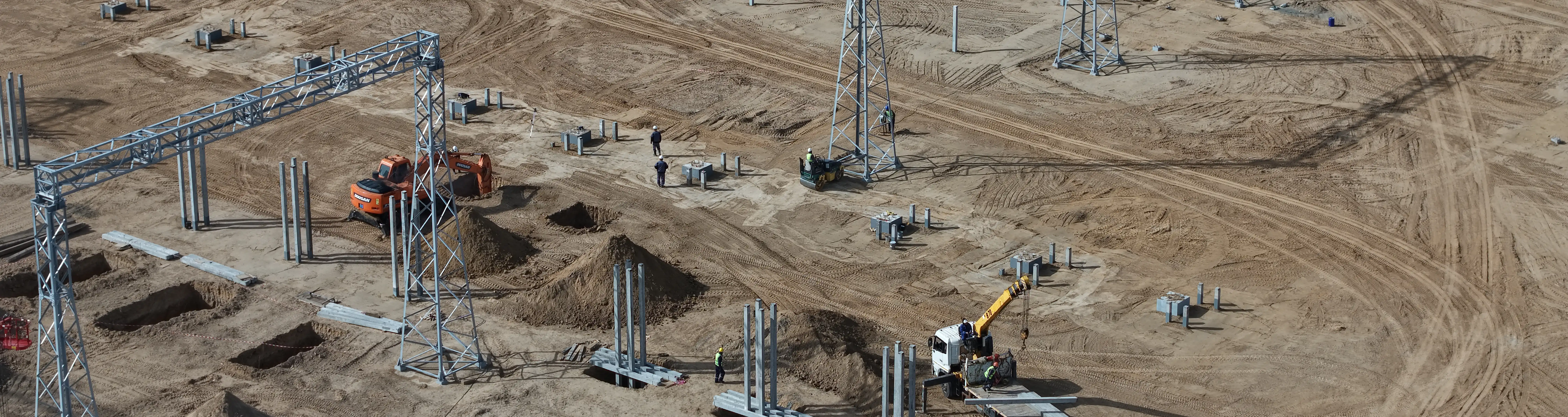
Work on the project is being carried out simultaneously at several sites, which makes it possible to maintain a high pace of implementation. A significant part of the measures is focused on substation infrastructure. At the 500 kV Shu, Zhambyl, and Shymkent substations, the main equipment has already been delivered in full. Commissioning works are currently underway at the facilities. At the same time, construction continues on two 500 kV power transmission lines with a total length of about 475 kilometers.
Commissioning of the facility is scheduled for July 1, 2027.
Integrating the west: new opportunities for the region’s development
A project of no less importance for the country is the integration of the West Kazakhstan power system with the main part of the Unified Power System.
Western Kazakhstan is one of the country’s key industrial regions, where oil and gas sector enterprises, processing industries, and major infrastructure facilities are concentrated. At the same time, the region’s power system has historically developed more autonomously.
The creation of a new infrastructure corridor is expected to improve the stability of the power system, enable more flexible power redistribution, and strengthen the reliability of electricity supply to consumers.
The project includes the construction of the 500 kV Karabatan substation, the reconstruction of the 500 kV Olke substation, and the construction of the 500 kV Olke – Karabatan overhead transmission line, which will extend for more than 600 kilometers.
Design and estimate documentation has already been completed for all facilities, and positive conclusions from the state expert review have been obtained. Work on the project is being carried out simultaneously at several sites, which makes it possible to maintain a steady pace of construction. Commissioning of the facility is scheduled for the end of 2027.
The company also specifically emphasizes the participation of domestic business in the project’s implementation. The autotransformers for the facility were manufactured by the Kazakhstani company Asia Trafo, reflecting the involvement of national industry in major infrastructure initiatives.
Energy as the foundation of economic growth
Both projects are significant not only technically, but strategically as well.
Strengthening the Southern zone will ensure reliable electricity supply to rapidly growing regions, integrate new capacity, and reduce the risk of overloading the existing grids.
Connecting the western zone with the main part of the UPS will increase the flexibility of energy flow management, strengthen inter-system connections, and create additional opportunities for the stable operation of industry.
In effect, this is about forming a new configuration of the national power system.
Against the backdrop of growing domestic demand for electricity, expanding industrial production, the digitalization of the economy, and the implementation of new investment projects, the resilience of the power system is becoming one of the key factors in the country’s development.
In this context, KEGOC’s infrastructure projects go beyond sectoral modernization and are becoming part of Kazakhstan’s long-term energy security strategy.
Strategic development priorities
As part of its strategic vision for the development of the National Power Grid through 2035, KEGOC has formed a pool of key infrastructure projects that are fully synchronized with the country’s generation development plans. These include strengthening Astana’s external power supply scheme through the construction of the new 500 kV Astana substation with a transformer capacity of 1 GVA, which will make it possible to meet the capital’s growing electricity needs and create conditions for connecting new consumers.
Another promising area is the construction of the North-South direct current transmission line, which will make it possible to increase the transmission capacity of the transit corridor of the same name to 2000 MW and improve the resilience of the power system amid growing loads, the development of renewable energy sources, and the commissioning of new generating capacity.
KEGOC is also developing a project for the power grid development of the Almaty region and Zhetysu region, which provides for the construction of a power transmission line along the Taldykorgan–Khorgos–Shelek route with a total length of about 450 km. The implementation of the project will improve the region’s power supply reliability and create additional conditions for the development of hydropower, RES facilities, cross-border infrastructure, and the connection of new consumers.
In total, the construction of about 7,000 km of new power transmission lines is expected by 2035. The implementation of these projects will ensure the country’s energy security, create ring connections between important energy zones, and create a reliable and resilient power system for Kazakhstan