Growing domestic gas demand has become one of the defining factors shaping the industry’s development. Natural gas is increasingly evolving from an energy resource into a foundation for industrial growth and improved living standards.
In 2025, Kazakhstan produced 68 bcm of raw gas, while trade gas output after processing reached 27.4 bcm.
One of QazaqGaz’s key assets remains the Amangeldy group of fields in the Zhambyl Region. For the national company, it is a strategic reserve that helps maintain stable annual supplies of 340–350 million cubic metres of gas.
This year, QazaqGaz is conducting seismic surveys across the promising Maldybay and Sayakbay structures. This approach reflects the industry’s shift towards a longer-term planning model, where not only current production levels but also the creation of future resource sustainability are of strategic importance. Under the state geological exploration programme, exploration activities are planned across three additional blocks in the Shu-Sarysu Basin, seven blocks in the Caspian Basin and three blocks in the Teniz sedimentary basin.
QazaqGaz currently holds six exploration contracts and continues to work with strategic partners on four of them: Shalkar, Akkuduk, Severny-2 and Severny-1. At the Saralzhyn block in the West Kazakhstan Region, seismic surveys and digital geochemical studies are scheduled for 2026. The company is working with Kazakhstan’s Ministry of Energy and Ministry of Industry and Construction to secure rights to 25 additional subsoil-use blocks. These areas are located across the Caspian Depression, the Aral region, Teniz, Shu-Sarysu and Ili basins. A comprehensive exploration programme is planned for 2026–2028. The initiative is expected to support the discovery of new large-scale natural gas fields.
Behind this extensive effort stand drilling crews, geologists, production operators and rotational teams responsible for the continuous monitoring of well performance. Their daily work transforms proven reserves into a tangible energy resource.
At the same time, deeper domestic gas processing is becoming increasingly important for Kazakhstan. The expansion of gas processing capacity is now viewed as one of the key pillars of energy security and domestic market stability. In this area, QazaqGaz is implementing several major gas processing projects.
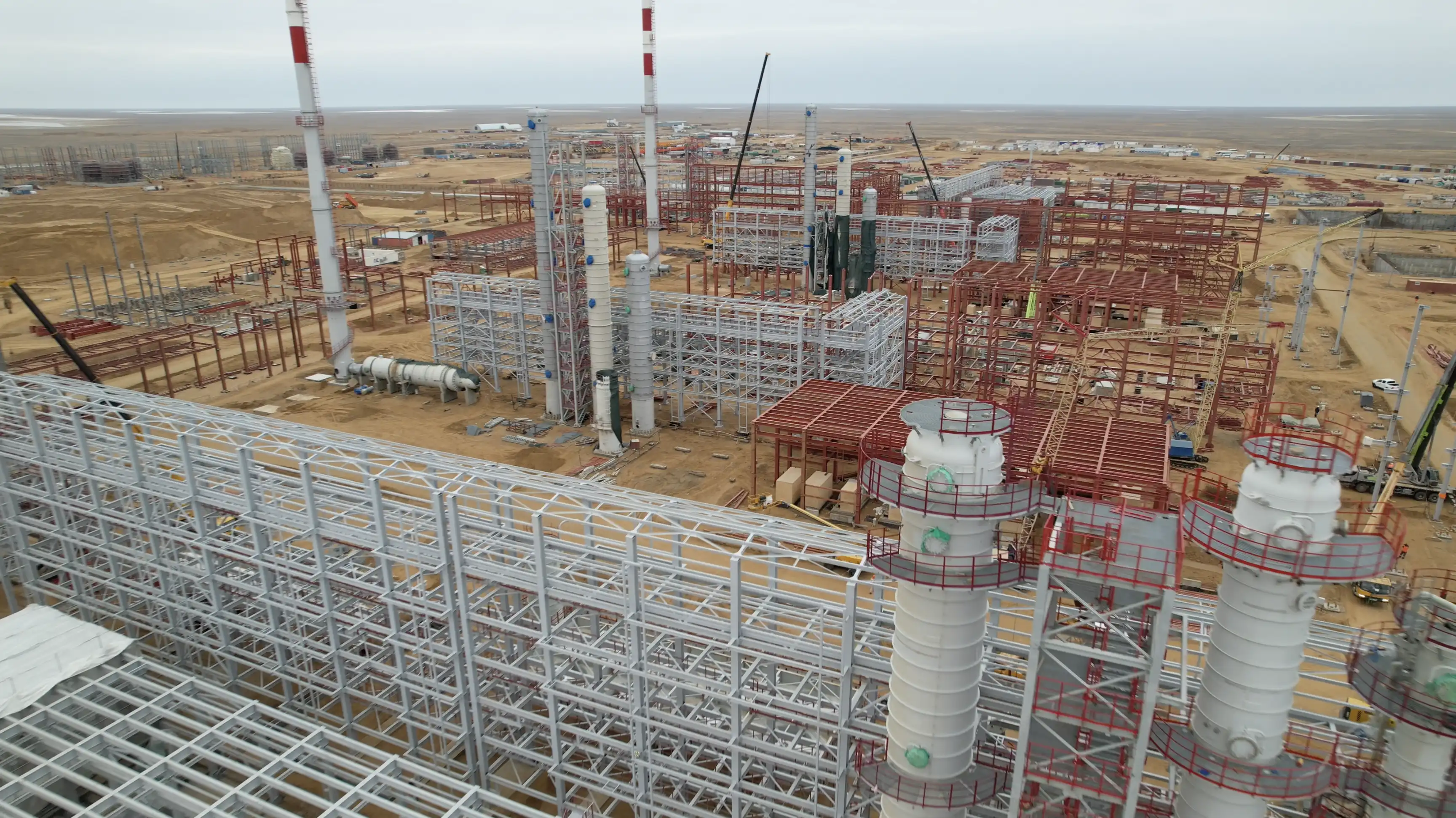
These include the construction of gas processing plants at the Kashagan field with capacities of 1 bcm and 2.5 bcm of raw gas per annum. The projects are expected to play a significant role in increasing marketable gas production.
One of the company’s principal strategic priorities is the construction of a gas processing plant at Karachaganak. In April 2026, Kazakhstan’s Ministry of Energy designated QazaqGaz as the sole operator of the project. The future facility will have an annual processing capacity of 5 bcm of gas. The project forms part of Kazakhstan’s Comprehensive Gas Industry Development Plan and is regarded as a key initiative for expanding domestic gas processing. Its implementation will help create a sustainable resource base for domestic consumption and support the continued development of the country’s energy sector.
Infrastructure and Transit
The development of production and processing capacities is directly linked to the reliable operation of Kazakhstan’s gas transportation system. Each year, the country’s pipeline infrastructure transports approximately 88.9 bcm of gas, of which 35.9 bcm accounted for transit volumes through the Central Asia–Centre, Soyuz–Orenburg–Novopskov and Bukhara–Ural trunk pipelines. These figures underscore the strategic importance of the transit business within the national company’s portfolio.
QazaqGaz manages more than 77,000 kilometres of gas distribution networks, 21,800 kilometres of trunk pipelines and over 287,000 infrastructure assets. The company supplies gas to more than 2.6 million consumers, representing over 12 million people across the country. More than 14,000 employees ensure the uninterrupted and efficient operation of this extensive system.
Behind these large-scale figures stand generations of skilled workers and entire family dynasties: compressor and gas distribution station operators, pipeline maintenance crews, dispatchers, mechanics, technicians, machine operators and welding specialists. They oversee technological processes around the clock, monitor pressure levels and flow balances, conduct diagnostics and maintain critical equipment.
The history of Kazakhstan’s gas industry is built on the dedication, expertise and determination of veteran professionals and previous generations. Traversing thousands of kilometres of mountainous and desert terrain, they created the foundations of the national gas system according to the principle “from wellhead to burner”, connecting regions and ensuring continuity across generations. Their strength, experience and mentorship remain embedded in the industry’s development. Today, family dynasties continue to play an active role on the front line of the sector’s growth.
Every shift and every pipeline inspection contributes to the reliable transportation of gas across thousands of kilometres without interruption. At the same time, pressure on infrastructure continues to increase. Peak demand during the 2024–2025 heating season reached 4,582 thousand cubic metres per hour, rising to 5,008 thousand cubic metres per hour during the 2025–2026 season. Over the past four years, peak demand has increased by an average of approximately 14%.
Underground gas storage facilities play an essential role in balancing seasonal fluctuations in demand. Their availability enables the maintenance of required gas reserves and helps ensure the country’s energy stability.
The Bozoi Underground Gas Storage Facility, located in the Aktobe Region, is the largest underground gas storage site in Kazakhstan. It is considered a strategically important national asset, with an active design storage capacity of 4 bcm of gas. By comparison, this volume would be sufficient to supply one million homes of 100 square metres each, or approximately 10 million apartments in multi-storey residential buildings, for an entire year. In addition to Bozoi, the company operates two other underground gas storage facilities: Poltoratskoye in the Turkistan Region, with a design capacity of 350 million cubic metres, and Akyrtobe in the Zhambyl Region, with a design capacity of 300 million cubic metres.
77,000 Kilometres of Gas Networks Under Control
At the same time, large-scale regional gasification efforts continue. In 2025, access to natural gas was provided to 350,000 people across 95 settlements. The national gasification rate reached 62.4%, while a further 41 settlements are scheduled to be connected in 2026.
For residents, this means a transition from coal to a cleaner fuel source and an improved quality of life. For the energy sector, it requires the systematic modernisation of infrastructure and maintaining its ability to adapt to growing demand. QazaqGaz continues to strengthen its efforts in industrial and household gas safety.
The uninterrupted and safe operation of gas distribution networks is supported by operational personnel, including emergency dispatch services, drivers and mechanics working around the clock. They respond to incidents, deliver equipment and materials, maintain vehicles and machinery, coordinate logistics, conduct technical servicing and ensure the continuous supply of gas.
Expanding International Partnerships
QazaqGaz continues to broaden cooperation with leading global energy companies, strengthening Kazakhstan’s position in the regional gas market. The company is implementing joint projects with international partners across exploration, production, processing, gas manufacturing and transit.
For many years, China National Petroleum Corporation (CNPC) has remained a reliable strategic partner of Kazakhstan in the energy sector. Together, the parties have delivered a number of major infrastructure projects, including the development of cross-border gas transportation systems, while continuing cooperation on the Severny-1 block and exports of Kazakh gas to China.
One of the flagship outcomes of Kazakhstan-China energy cooperation is Asian Gas Pipeline LLP, the operator of the Central Asia–China gas pipeline across Kazakhstan.
The Kazakhstan–China project has generated substantial tax revenues, created new jobs and provided the foundation for a modern gas transportation infrastructure. The company manages a strategic asset of considerable importance for both the national economy and international cooperation.
Another major result of this partnership is the Beineu–Bozoi–Shymkent gas pipeline, one of the largest pipeline projects in the history of independent Kazakhstan. In 2026, the project marks the 15th anniversary of the establishment of the Beineu–Shymkent Gas Pipeline joint venture, founded on a parity basis by QazaqGaz and Trans-Asia Gas Pipeline Company Limited. The pipeline runs through the Mangystau, Aktobe, Kyzylorda and Turkistan regions, reducing the dependence of southern Kazakhstan from imported gas while integrating the country’s key gas transportation systems.
Long-standing cooperation with Gazprom continues to deepen, with increasing volumes of Russian gas transiting through the Central Asia–Centre trunk pipeline system to Uzbekistan and Kyrgyzstan.
A successful example of long-term partnership is KazRosGas LLP, established by decision of the Presidents of Kazakhstan and Russia in June 2002. Since its inception, the company has been tasked with processing raw gas from the Karachaganak field and supplying marketable gas to both domestic and international markets. This mission has represented not only a commercial objective but also a significant contribution to Kazakhstan’s economy. Today, KazRosGas continues to fulfil this strategic role by marketing gas processing products domestically and internationally while advancing new projects within the framework of Kazakhstan-Russia strategic cooperation.
QazaqGaz is steadily building an integrated model for the development of Kazakhstan’s gas industry from expanding the resource base and commissioning new processing facilities to modernising infrastructure and extending gasification. Amid rising domestic demand, this strategy is becoming a cornerstone of the country’s long-term energy security and economic development