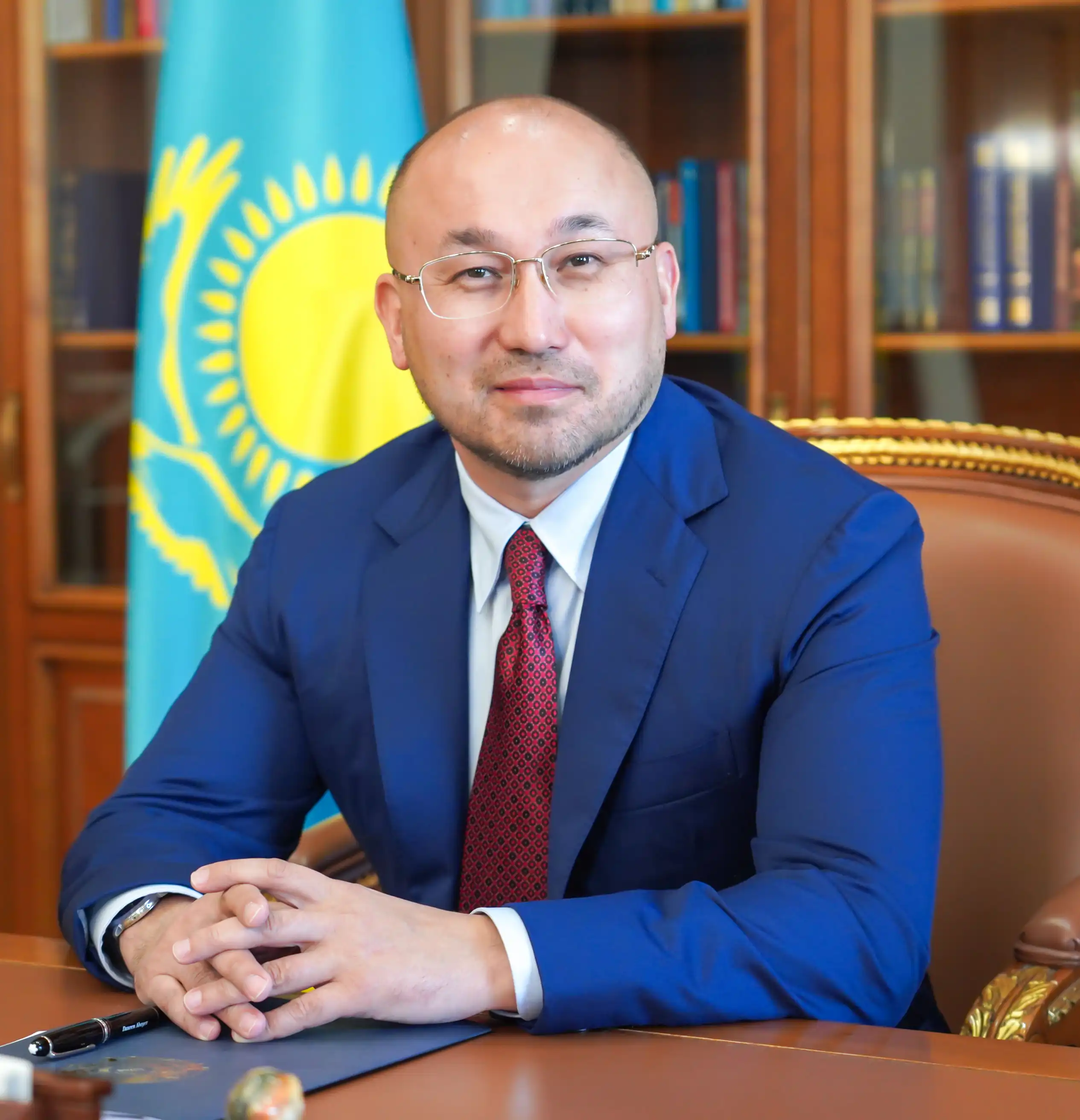
- In November 2025, a state visit by the President of Kazakhstan to Russia took place. How would you characterize its results? Which agreements, in your view, are most important in terms of long-term impact for Kazakhstan?
- The state visit of President Kassym-Jomart Tokayev to Russia was truly a historic event, marking a qualitative rise across the entire spectrum of bilateral relations. The leaders held a substantive exchange of views on key regional and global issues and reaffirmed their determination to further deepen cooperation.
Of particular significance is the signing of the declaration to elevate relations to a comprehensive strategic partnership and alliance.
The agreements signed are comprehensive in nature. There is virtually no area in which Kazakhstan and Russia do not engage fruitfully: industry, the agro-industrial complex (agribusiness), education, environment/ecology, space. It is precisely this all-encompassing scope that makes our partnership unique.
Of fundamental importance are the Comprehensive Economic Cooperation Program for 2026–2030 and the agreement to establish an intergovernmental commission to conduct flight tests of the space rocket complex ‘Soyuz-5’ and ‘Baiterek’.
Agreements in energy and transport will ensure longterm effects: the nuclear power plant (NPP) project, expanded gas supplies and oil transit, development of international corridors, and modernization of logistics.

- I would note separately the plan to prepare for the introduction of Amur tigers into Kazakhstan. This is an important scientific experiment based on genetic research that confirmed the closeness of the DNA of the extinct Turanian and Amur tigers.
An important event was the presidents’ participation in the 21st Interregional Cooperation Forum, where about one hundred companies concluded agreements totaling $61 million. The forum proves its effectiveness every year and is an important part of bilateral interaction.
Without exaggeration, the visit opened a new chapter in relations between the two countries and created a solid foundation for further strengthening the Kazakh–Russian partnership.
- Which economic projects between Kazakhstan and Russia do you consider the most promising? Are there new areas—digital economy, logistics, green energy—where the countries could engage more actively?
- Our joint investment portfolio includes 175 projects totaling $56.6 billion, of which 114 have already been implemented by Russian companies—Tatneft, Rostselmash, KAMAZ, Transmashholding, Sibur, EuroChem, Metalloinvest, Inter RAO, Polymetal, Uralkali, TechnoNICOL, and others.
Thirty projects totaling $4.4 billion are in progress, including expansion of existing facilities and creation of new ones, field development, geological exploration, construction of a greenhouse complex, localization of engineering/ manufacturing, and others.
Cooperation in transport and logistics is showing steady growth. In the first eight months of 2025, rail freight volumes between our countries rose 3.2% to 58.4 million tons.
One of the most promising routes is the North–South corridor. A joint “roadmap” is being implemented that provides for eliminating bottlenecks and gradually increasing throughput capacity.
I would single out the project to build a transport and logistics hub in Selyatino (Moscow Region). It will create additional advantages for Kazakh shippers, including access to East Asian markets.
There is significant experience in green energy. Hevel has installed solar power plants in six regions of Kazakhstan, including the Akmola and Turkistan Regions and Shymkent.
Kazakhstan has traditionally advocated expanding cooperation in digitalization: transport, technical regulation, traceability of goods. Major opportunities are opening up here that will accelerate interaction across different sectors.
- How does the embassy help strengthen humanitarian and cultural ties between our countries? Which joint initiatives are especially close to your heart?
- Cultural and humanitarian cooperation traditionally occupies a special place on the bilateral agenda of Kazakhstan and Russia. It is the most effective bridge-building tool: joint political and economic projects bring minds closer, while culture brings hearts closer, enabling a better understanding of the character, values, and aspirations of ordinary people.
The cultural dimension of our cooperation is becoming more vibrant each year.
Sultan Baybars,” was staged on the stage of the Mossovet Theater.
To mark the centenary of the outstanding Kazakh composer Nurgisa Tlendiyev, a major concert was held at Moscow’s Helikon-Opera and received resounding applause from the discerning Moscow audience.
Creative ensembles of the Armed Forces of Kazakhstan are taking part in the 17th International Military Music Festival Spasskaya Tower (festival).
Our artists actively represent the country in music competitions. This year, Kazakh singer Alex Lim (Alexander Lim) won the New Wave competition for young performers, and at the International Music Contest Intervision our singer Amre (Yernar Sadirbayev) represented Kazakhstan with distinction.
In the fall, the Days of Culture of Kazakhstan in Moscow opened with a ceremonial exhibition, “Masterpieces of the Art of Kazakhstan,” from the collection of the A. Kasteyev State Museum of Arts of the Republic of Kazakhstan at the New Tretyakov Gallery.
At the Poklonka cinema of the Victory Museum in Moscow, the Days of Kazakh Cinema were held. Works by Kazakh directors from recent years were shown: “Time of Patriots,” “Summer of 1941,” the film musicals “Stop, Night” and “Dos-Mukasan,” the animated film “Altyn Adam,” and the soccer drama “90+1.”
As part of the Days of Culture, the stage of the Maly Theatre on Bolshaya Ordynka hosted a performance of “Parassat Maidany” by the Kalibek Kuanyshbayev Kazakh National Musical Drama Theater. During those same days, the Almaty Theater named after Natalya Sats came to Moscow on tour.
The main event of the Days of Culture was the gala concert of Kazakhstan’s masters of the arts on the historic stage of the Bolshoi Theatre on November 12 in Moscow, which was attended by the presidents of the two countries.
- In your view, in what areas should educational and youth exchanges between Kazakhstan and Russia be developed to build new bridges of trust between generations?
- Cooperation in education is one of the key elements of humanitarian cooperation.
Today Russian universities are, by many measures, at the forefront of global scientific and educational progress. Nearly 60,000 Kazakh students study in Russia—more than from any other country. Geographic proximity and the absence of a language barrier ease adaptation. Bilingualism is an important advantage for Kazakh youth.
An important event this year was the opening in Russia of the first foreign branch of a university—the branch of Kazakh National University (KazNU) named after al-Farabi at Omsk State University named after F. Dostoevsky—and a branch of MGIMO in Astana.
A special role is played by cooperation among search teams—the noble mission of perpetuating the memory of fallen soldiers. President K.-Zh. Tokayev, in the article “Eternal Friendship Is a Guiding Star for Our Peoples,” expressed gratitude to volunteer searchers.
A promising area noted by the leaders of the two countries is student labor brigades. Russian President Vladimir Putin recalled that their history began in 1959 precisely in Kazakhstan and invited Kazakh citizens to the World Festival of Youth and Students in Krasnoyarsk in 2026.
Such initiatives strengthen trust between generations and stimulate the exchange of experience.
- What issues most often arise among citizens of Kazakhstan living or studying in Russia? How does the embassy help resolve their problems and protect their interests? Is an expansion of consular services or new formats of engagement with compatriots planned?
- Consular work is the most dynamic, because it is connected with people. We provide the full range of government services: citizenship, documentation, notarization, and civil registration.
Diplomats assist citizens who are under investigation or in correctional institutions: they explain rights, inform relatives, and establish contact with attorneys.
Assistance is provided in emergency situations and when health problems arise. The embassy serves as a link between the state and our citizens, providing support within the scope of its authority and the laws of the Russian Federation.
On an ongoing basis, information outreach is conducted and the rules for staying in Russia are explained. The Ministry of Foreign Affairs and embassies monitor the need to expand consular services and promptly inform citizens.
- How do you assess the perception of Kazakhstan in Russian society today? In your opinion, what should be done to strengthen mutual trust and interest between peoples?
- There are not many peoples in the world that possess such a common set of spiritual and cultural values and such an interweaving of human destinies as the Kazakh and Russian peoples. We are united by a shared centuries-long history, a similar mindset, and close economic and spiritual ties. A living bridge is formed by more than 700,000 ethnic Kazakhs in Russia, about 3 million ethnic Russians in Kazakhstan, and, as I noted above, tens of thousands of Kazakh students studying in Russia.
I would like to draw attention to another very important aspect. Kazakhstan and Russia maintain a simplified procedure for mutual travel—using internal national identity documents and with no mandatory registration for stays up to 30 days. This is an indicator of mutual trust. As a result, our countries lead among popular travel destinations for each other. This is supported by 160 flights a week across 26 routes. Also, in October of this year, direct passenger rail service between Almaty and Moscow was restored.
We need to do everything possible to ensure that the bonds of friendship and cooperation multiply. We have all the prerequisites for this, and the main ones are the goodwill and desire of the political leadership and the peoples of our countries