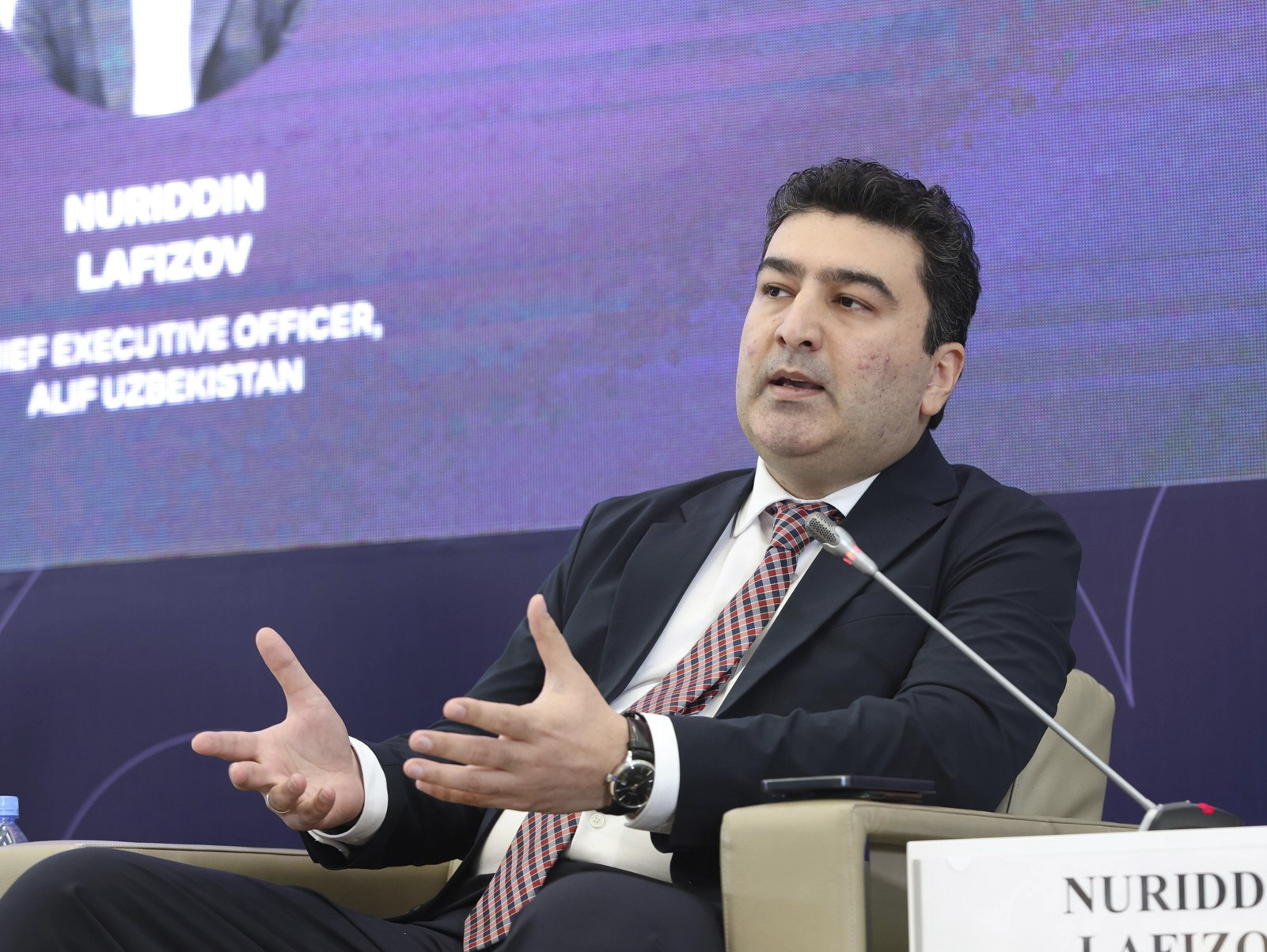
– Nuriddin, what makes Uzbekistan’s financial market attractive to investors today?
– Uzbekistan’s financial market is in a phase of active growth. The regulator is consistently developing the sector, competition is increasing, and companies are seeking to occupy their niches and offer customers new products. I think this momentum will continue over the next few years.
Today, Uzbekistan is one of the most dynamic markets in Central Asia. This is supported by economic reforms, government policy, the fintech development strategy through 2030, privatisation, and the emergence of new players. Taken together, these factors are attracting investors from different countries.
– You have been participating in Astana Finance Days for the fourth year. What practical results has this engagement produced?
– This year, Alif Uzbekistan is preparing an issuance of Islamic bonds on the Astana International Exchange. This is a significant event for us: it is the first public issuance of Islamic bonds by a private company from Uzbekistan on the Astana exchange.
Teniz Capital is acting as the placement arranger and lead underwriter for our issuance. For the investment bank, this is already the third issuance of Islamic bonds — sukuk — that it has supported, and it has extensive experience with this type of placement. Our colleagues at Teniz Capital shared with us their view that they are currently seeing strong demand for this type of security.
The bonds will be available for purchase through the Tabys Pro mobile investment app.
– Which area will the funds raised be used to develop?
– The funds from Kazakhstani investors will be directed towards the development of Alif’s business in Uzbekistan, primarily its instalment payment service. Alif is among the five largest fintech companies in the country and is one of the leading players in this segment.
We operate in all 14 regions of Uzbekistan. Instalment payments through Alif are available at 12,000 retail outlets, while 9 million users are registered across our services. To further develop this area, the company needs to attract additional resources.
– What could make this issuance attractive to private investors in Kazakhstan?
– The issuance is aimed at retail investors. We want to offer a competitive yield so that the instrument can compete with bonds issued by traditional financial institutions.
The expected yield will be around 10% per annum, and the bonds will be denominated in US dollars. For a dollar-denominated instrument, this is an attractive level, so we expect strong demand. An additional advantage may be the structure of the issuance, which complies with the principles of Islamic finance.
We expect that Kazakhstani investors will be able to diversify their portfolios through our securities and, at the same time, participate in the growth of our dynamically developing economy.
– How does the AIX placement differ from the company’s experience in other jurisdictions?
– Two years ago, we placed private bonds in Luxembourg. We have now begun the placement on AIX, and in Astana the process is noticeably smoother. The AIFC and AIX have created the necessary infrastructure for the successful issuance of such instruments.
The Tashkent International Financial Centre has also been established in Uzbekistan and is expected to begin operations in January next year. We hope that comparable conditions for the development of Islamic finance will emerge within its framework.
– What other areas of cooperation with Kazakhstan is Alif Uzbekistan developing?
– We actively cooperate with Kazakhstani financial institutions in several areas. These include attracting financing for projects in Uzbekistan, cooperation within professional associations, and the exchange of experience between the two countries. This dialogue is ongoing